This blog is dedicated to those esoteric activities directly or indirectly related to miniature gaming, boardgaming and Euro-gaming.


Showing posts with label 15mm. Show all posts

Sunday, December 3, 2017

The Battle of Raab, 1809 - 3rd time around

Recently we re-fought 'The Battle of Raab, 1809' for the third time. We used Napoleon's Battles 4th Ed. rule set and a revised scenario, which has since been extended with some 'Additional Options' to provide some options to further balance the scenario.

You may want to read the scenario is available here.

This time, we recorded the game using a time lapse from an overhead web cam.

Enjoy. Comments and questions welcome!


Thursday, June 2, 2016

Little Wars 2016 - The Battle of Raab, 1809: A 2nd Outing

Somewhat confusingly, I'm posting a quick AAR for the second outing of this scenario, held at Little Wars 2016, in Moorabin, Melbourne this weekend past.

So, after a very short discussion, my gaming buddy (Vince) and I decided to put our hard work on public display.

In preparation we modified the scenario from the learnings from our initial playing. Due to a lack of time, despite intentions, we weren't able to swap out any of our older figures with any newly painted ABs - maybe next time.

An early start on Sunday morning saw us travel from the north side of Melbourne to the southern suburb of Moorabin and the Kingston City Hall.

We quickly set up the board and I laid out a pre-prepared defense.


Vince set up to attack in the center and on the Austrian right flank, an a-historical, but interesting alternative to the strategy employed from our first game (an attack on the center and on the Austrian left flank). Below, Eugene contemplates the field before him.


I don't have many pics at hand to show the development of the attack. Fundamentally, the Austrians had to realign to the French attack which unbalanced things for a while. However, the realignment managed to present problems for the French and a number of attacks were made, some repulsed, others drove home. Kis Megyer proved a tough nut to crack with a strong Austrian Line Brigade in the fortified farm complex.

Suffice to say it was a see-sawing affair, and by the time we had to pack up, the game was in the balance. Here are some quick smartphone snaps of the state of the game - from the Austrian left to right.


We are looking forward to our next replay and will hope to learn from our second play, and right our strategic and tactical wrongs in the process.

Let me know if you have any questions or comments.

Thanks for looking.

Thursday, March 3, 2016

Refight of the Battle of Raab, 1809. Part 1: Preparations


Our progress to this refight can only be described as “A marathon … and then a sprint … and then a game!”.

This is the first in what will be 3 parts covering our experience of firstly preparing for and then playing what turned out to be a fun game.

Our project to refight the Battle of Raab has been in progress for literally years. This is evidenced by the age of my blog posts with the label ‘Raab’ (see them all here – including this one!), which stretch back to 2010!

Well, a few months ago, we committed to putting it all together. The original plan was to hold the game over the long weekend adjacent the Melbourne Cup Day holiday as a part of a regular annual event for our gaming group. For various reasons this event didn’t happen (we were not ready in any case) and we ended up organising an ad-hoc, short notice outing for the scenario version 0.1 in mid-December. What follows is the preparation, the refight itself and the wash-up.

Preparations

The Rules:

We have used Napoleon’s Battles for many years. The recently released version 4 was used for the first time by us in this game. As we had a noob, we opted for using the standard rules (with a few minor, but playable optionals, but importantly no Initiative or Re-rolls) and played the slightly less onerous interpenetration rules. We own NB2 and NB3 and used various items from these rule sets, such as markers and templates, as these are not changed in NB4.

The updated NB4 Built Up Area and Fortification rules are relevant for Kis Megyer and forces the French to attempt a cold steel approach to taking it.

For those not familiar, these rules are designed for Army and Corps level actions and the basic unit is a brigade of infantry or cavalry. Only Heavy and Horse artillery are present, with medium guns abstracted into the brigades. A heavy reliance on command and control exists in the game and as will be seen, is a problem for the army structure of the Austrians which without Corps.

The Painting:

While we didn’t quite achieve what we were hoping for in terms the painted figures in the order of battle, we fielded the full scenario OB.

The original goal was to field a pair of armies consisting entirely of only AB (Anthony Barton) figures from Eureka. In our collections are significant numbers from the Hinchcliffe, Minifigs, Empire and Battle Honors ranges, and these filled the gaps where our painting plans fell short.

These two brigades of French Cavalry were painted on commission by Gunner Dunbar - my basing.

Reinforcements by (Australia) Post courtesy Gunner Dunbar and 'benefactor'


Some last minute ring ins (more French Cavalry and the Baden Brigade) came from Hinde’s.
However, I have to say that the 4 weeks leading up to the game saw significant personal production output, including the completion of painting of 5 brigades of Insurrection Hussars, the basing of 9 brigades of Cavalry and one of Infantry, and the painting and basing of two divisional commanders and a limber. This is a record for me, and likely never to be matched. I was helped by the earlier mass painting of the horseflesh.


WIP Insurrection Cavalry – ready for basing

Basing Production Line


Austrian Divisional Commanders - WIP


Cavalry Panorama – that is a LOT of (extra) cavalry!

The Battlefield:

This was the most prepared part of the event. Details of the terrain board can be found here.
Below is taken from Gill (my grid pattern, slightly compressed scale, 1:1.2, with each square, 1.2km square to fit into a 6’ by 5’ table). Note: Raab city is to the NE.


A couple of additional shots are below which include the entire final setup including the 30cm modular extensions are below. Note that the fields and trees are cosmetic.


A French perspective of the field.

From the Austrian side, with Kis Megyer in the centre. The town of Szabadhegy is 3 Built Up Areas.

From the Austrian side


The Scenario:

We drew inspiration from the official NB3 Raab scenario, but also from the works by Bowden & Tarbox, and the more recent trilogy from Gill. Gill was used heavily for the OB. Bowden (and also Gill) for the terrain and initial dispositions.

A link to the Scenario Card we used is here. It is somewhat in draft! As this was a first attempt at the scenario, we were guided by the NB3 scenario for Victory Conditions, based on control of the major battlefield features being Kis Megyer, Szabadhegy, etc.

Three key elements of the battlefield that strongly impact the balance are Kis Megyer (a fortified farm), the historical difficulty the French cavalry had crossing the Pandza on their left and the movement penalty presented along the length of the Pandza. How much of an impediment and protection these are for French and Austrians is key to a balanced game. Gill referred to two items which we incorporated into the scenario terrain, i.e. the discovery of a small bridge that enabled the French left to finally cross the Pandza, and the way in which the Viscay (a rivulet) disordered the inexperienced Insurrection cavalry. There are many options for the scenario in relation to the terrain itself, however we settled for the following special rules (and adjusted as below):

"All buildings have a +1 combat modifier, except Kis-Megyer, which is a +3 fortification.
The Pandcza stream is fordable by infantry and generals at all points, although infantry must be in column or march column formation to cross. It is fordable by cavalry and artillery only at a ford and they must be in column, march-column or limbered formation to cross, or at a bridge.
The Viscay rivulet is a minor obstacle and the following scenario special rule applies: Inexperienced Cavalry are disordered crossing this obstacle unless they do so in column or march column using a ford. No movement penalty applies for crossing this obstacle (Designers note: historically, the Insurrection Light Cavalry were disordered by this obstacle and this rule is present to represent this)."

We also opted for a D10 roll for the French to find the crossing. On arrival at the location (1), a 1, then 3, then 5 etc per movement phase spent searching for the crossing, before being able to cross on the subsequent movement phase. The crossing was deemed a Bridge (after Gill) rather than a ford. This makes a difference under NB4 rules.

A similar approach for the arrival of the RD Austrian reserves was taken. Neither of these updates are in the draft scenario card.


(Next up the refight itself)

Drop any questions in the comments below, or just let me know what you think!

Saturday, April 4, 2015

15mm German Grenadiers - First Batch

Just a quick post to show some of my slow progress on painting some WW2 German Grenadiers for IABSM.

These are BF plastics from the Open Fire box. Not the greatest 15mm figures I ever painted, but they are also, not the worst.

After spending a lot of time researching, the guides by HeresyBrush and Flame Of War are pretty useful.

There are some uniform and colour variations as I was experimenting and learning!

Sorry about the photos - they are a bit lacking as I had to get this done in a rush.

Let me know what you think.


Wednesday, November 26, 2014

More Terrain Diversions - Buildings

Painted some building that have been in the cupboard for a while (a long while) ...

From memory (literally) these are from JR Miniatures in the U.S.


Tuesday, November 4, 2014

Wall Diversion

Just some terrain painting as a diversion from the recent mini painting.

Mostly used an airbrush, with a brush for touch ups, some dry brushing and a final black wash followed by some clean up with water and cue-tips.


Sunday, November 2, 2014

Open Fire! Pak 40s - lazy Sunday afternoon

A cold and quiet afternoon here and so after looking at this video I was inspired to do the Pak 40s from the Open Fire! box I received for Father's Day.

For the first time I attempted a modulation technique, along with now more familiar techniques for pin washing, applying a filter, chipping and weathering using enamels.

Hope you like the results. Feel free to leave a comment.


Saturday, November 1, 2014

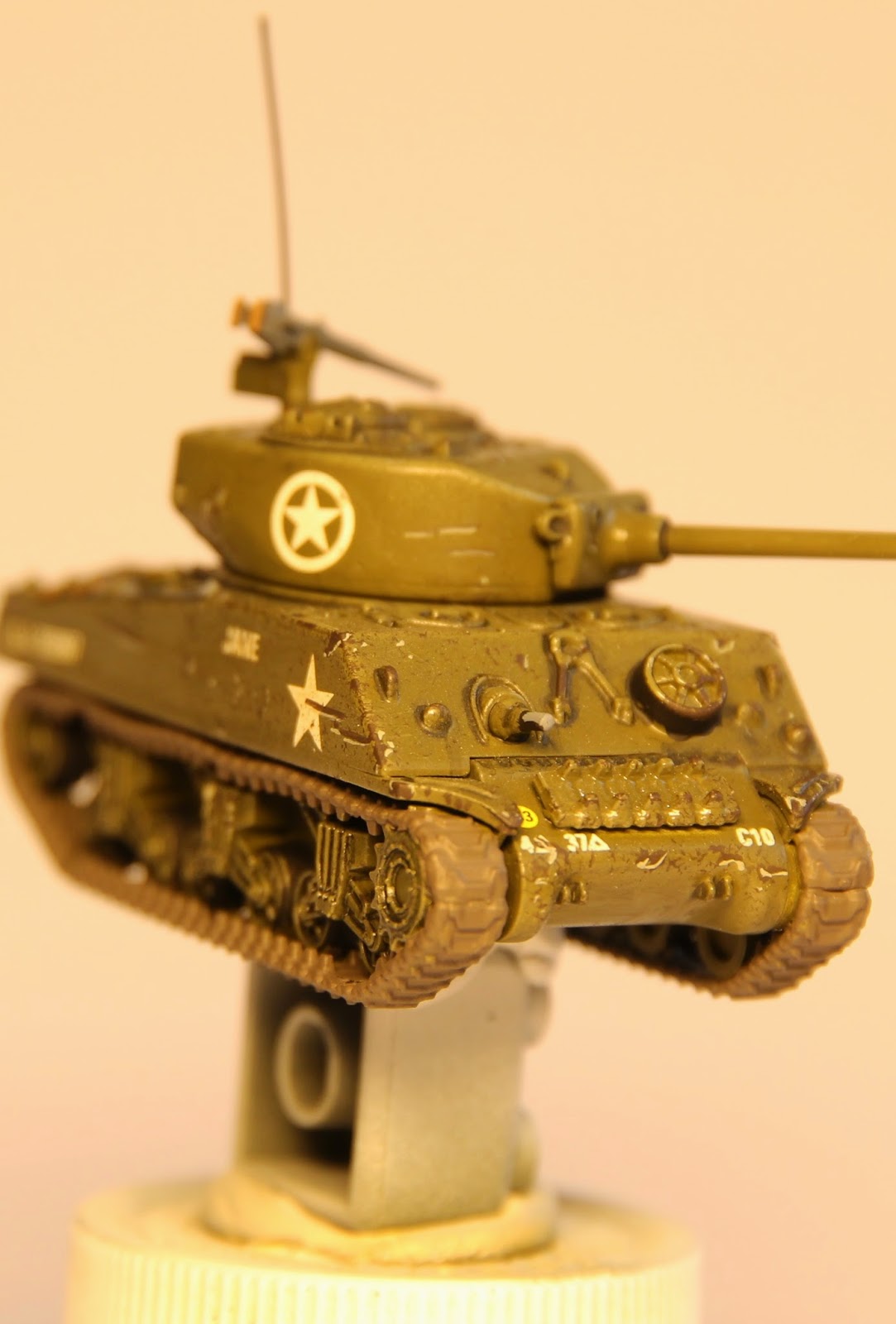
PSC M4A3 (W) Shermans - Finished!

I have completed the pack of 5 PSC Shermans.

I have tried to weather these more realistically than the Russian Tanks (here) I finished before - still they turned out a bit rougher than I had first intended. Take a look here to see how they looked prior to weathering and completion of details and tracks.

My only disappointment is with the dust effects I achieved with pigments was lost when I applied a coat of gloss varnish (for protection). I need a new method here - maybe I'll try a matt varnish after the dust and that will help keep the dusty look?

Here they are - hope you like them, Leave a comment!


Saturday, October 18, 2014

Painting the PSC 15mm Shermans (WIP) ...

I bought a 5 pack of these models as my first 15mm WW2 purchase, with entering the world of FoW in mind.

This was after viewing this video on ThePaintingClinic YouTube channel which inspired me to attempt the painting and this then got me thinking about the gaming side too. It has been a long time since then and getting these models to this point, including deciding on IABSM in preference to FoW, and researching various techniques on AFVs and 15mm WW2.

This M4A3 (W) 76mm is ready for track painting and final weathering. The chipping is complete, and hopefully approrpriate enough and not a-historical or unrealistic.

Decals are Battlefront. Paints are Vallejo (Model Colour and Panzer Aces). Weathering will be AK Washes and Streaking Grimes.

Let me know if you want any info and what you think by leaving a comment!


Weathering experiments - pushing the limits on two 'old Russian dogs of war'.

I found these 1/100 T-35 and KV2 Zvezda models in my FLGS and couldn't resist.

Having been inspired (or perhaps possessed!) after reading the chipping and rust sections of Mig Jiminez' FAQ2, I wanted to try out some of these ideas in 15mm scale.

Yes so these are a bit over the top, but my 'story' behind these old and rusty behemoths is that they are survivors, grognards, aged soldiers - and they look their age!!

These models are literally a snap to put together, I spent less than 15 minutes each getting them built ready for undercoating. The only additions I made was scoring on the side skirts of the T-35.

I really enjoyed trying some new techniques here, and will refine them for the future - although I have another T-35 undercoated who will get similar treatment!

Let me know if you have any questions about techniques and products. Thanks to the FAQ2 book, HeresyBrush and ThePaintingClinic for ideas and inspiration.


Both together ...